When I first started learning Flutter, I honestly didn’t know what I was getting myself into.
I was so confused at the beginning. Is Flutter worth learning? Can I actually get a job with it? What else should I learn apart from Flutter? And, like most people starting out, I was also curious about how much a Flutter developer could earn.
I didn’t have clear answers back then. I just started learning and slowly figured things out as I went.
It’s been around 1.5 years now, and I’ve learned quite a lot during that time. Some things went smoothly, while others took much longer to understand than I expected.
One of the first things I liked about Flutter was being able to see the result of my work quickly. I’d change something, run the app, and immediately see what happened. That made learning a little more enjoyable.
I also liked the fact that I could use a lot of the same code across different platforms. That was one of the things that made Flutter interesting to me when I was getting started.
But after using Flutter for a while, I realized that knowing Flutter alone wasn’t enough.
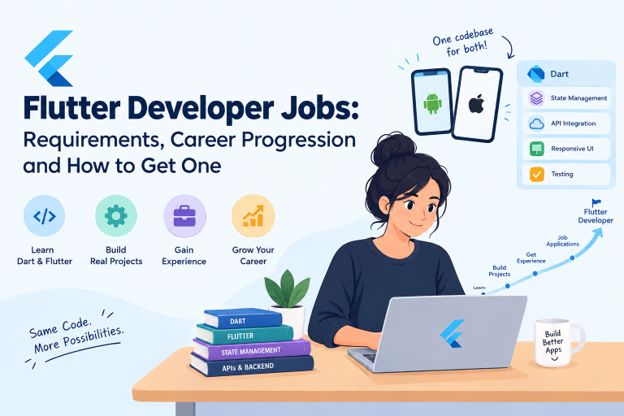
There was Dart, APIs, GitHub, state management, responsive UI and plenty of debugging. Some of these things I expected to learn, while others came up naturally when I started working on real projects.
Debugging was probably one of the things that took me the longest to get comfortable with.
There were times when I knew exactly what I wanted the app to do, but I couldn’t understand why it wasn’t doing it. I’d check the code, change something, run the app again, and then realize I’d somehow created another problem.
If you’re starting out, don’t look at a job description and feel like you need to know everything before you can even apply.
I’d begin with Dart.
Get familiar with the basics first. Functions, classes, objects, collections, null safety and asynchronous programming will come up first, so it’s worth spending time on learning them.
Once you have the basics, start making something with Flutter.
Learn how widgets and layouts work, then get into navigation, forms and responsive design. I understood some of these things much better when I actually needed them in a project. Reading about something and using it are two very different experiences.
I also wouldn’t try to study every concept at once. Take one thing, use it for a while, make mistakes with it, and then move on to the next.
You don’t need to be a designer. But you should pay attention to how your app looks on different devices. A screen can look completely fine on your phone and then look awkward when you open it on a tablet.
When it comes to salary, there isn’t one fixed number for Flutter developers in India. It can vary based on experience, location, company, skills and the kind of work you’re doing.
The Glassdoor 2026 figures I found during my research show a reported base-pay range of around ₹3 lakh to ₹6 lakh per year, with average base pay at roughly ₹4 lakh.
I wouldn’t take those numbers as something you should expect to earn automatically. They’re useful as a rough reference, but everyone’s situation is different.
I’ve also noticed that years of experience don’t always tell the complete story.
Two developers could have similar experience but spend their days doing completely different things. One might mostly work on UI, while another could be handling APIs, authentication, bugs, testing and releases.
That’s one reason I’ve started paying more attention to what I can actually do rather than focusing only on the number of years I’ve worked.
If you’re learning Flutter, I’d definitely recommend making some projects of your own.
Tutorials are useful, but there’s a big difference between watching someone build something and trying to build it yourself. When you’re following along, you already know what the next step is. Your own project doesn’t work like that.
You have to figure things out yourself.
I’ve run into API problems, UI issues and bugs that took much longer to solve than I expected. At the time, they were frustrating. Looking back, those are some of the situations I learned the most from.
These days, when something breaks, I don’t feel a need to solve it immediately. I usually go through the code, test things one by one and try to narrow down what caused the problem.
If you’re thinking about learning Flutter, you don’t need to wait until you feel ready.
Start with Dart. Build something small. Get stuck. Fix it. Then build something else.
You won’t understand everything straight away, and that’s completely normal.
After 1.5 years, I still have plenty to learn. But I’m much more comfortable with the process than I was when I started.
I don’t know exactly where Flutter will take me next, but for now I’m enjoying learning, building things and figuring out problems as they come.