React Vs Angular: What should a Beginner Learn?
React Vs Angular: What should a Beginner Learn? Author: Muhammed BilalI kept seeing this question repeatedly when I started to…

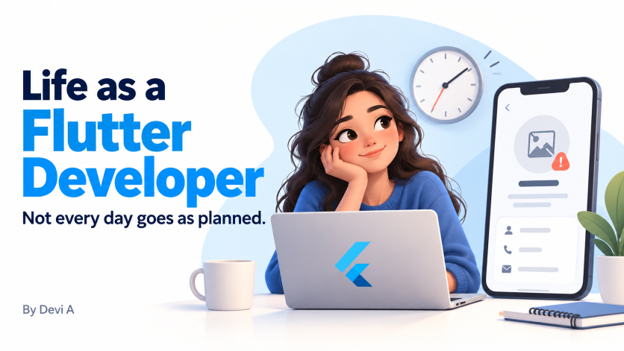
Have you ever decided to complete some task within an hour, only to find out that the task consumes your entire afternoon? Something similar may occur during application development.
Think of when you are asked to include a profile page on an already existing Flutter application. You have organized everything and added all the information about the user to be displayed. Everything seems good until the image fails to load.
The original task hasn’t changed, but there’s suddenly much more to do.
That is why I would not consider a developer using the Flutter framework to be solely coding. Bringing the feature to fruition is one thing but ensuring that the feature functions correctly in varying situations is another.
When someone opens an app, they usually care about one thing: does it work?
They don’t see the time spent adjusting a layout or checking why a button isn’t responding. They just expect the screen to load and the information to be correct.
Take an expense tracker. Showing a balance and a list of transactions is the easy part to picture. But what if the user hasn’t added any expenses yet? What should happen while the data loads? And if the app cannot retrieve the information, should the screen remain empty?
They may be small things, but they do impact the user’s experience of using the application. A developer must take these into account before declaring a feature ready.
This is why API integration is a perfect case study when it comes to solving problems that initially seem quite easy.
For instance, let’s say that your app should show some products in a list view, but it turns out there are no products being shown. The first thought that comes to mind is to blame the UI. In reality, however, the response from the server can contain some field which is not handled by your model or the request itself was not successful.
Making changes to the layout will not help to deal with any of the above issues.
That is the strange thing about debugging: the time spent finding a problem can be much longer than the time spent fixing it.
Tutorials are great in the beginning when you start using Flutter. They teach you about widgets, Dart language, how to create basic screens.
This is where it gets difficult because you are doing things which aren’t covered by the video tutorial. This is where you have to figure out how to design your application, manage states, store data, and manage errors.
I would advise to start with a simple project rather than building some complex app right away. Notes app will do for starters. After that, you can make your project more advanced and add local database, search function, or even use an API.
Sometimes you’ll have to google some things. It’s normal. The important part is to understand the principles of how everything is connected, not just copy working code.
Flutter development can work well for those who like to create and who are ready to dig into the problem if it arises. Not all tasks are interesting, and even if you understand the framework, it doesn’t guarantee it.
There is still much to discover after developing a couple of applications, especially when talking about testing, structuring code, and maintenance of the previous functionality.
Those who are interested in this profession should try creating an app from scratch and identify what tasks they enjoy. They might find the process of interface design or bug fixing more fun than API implementation.
No one knows how to do everything from the beginning, but they have to start from something.
Curious about developing mobile apps using Flutter and Dart frameworks? Edure Learning is a perfect choice when it comes to learning how to develop mobile applications using Flutter and Dart frameworks. Take advantage of the chance to learn app development and overcome practical difficulties. Connect with Edure Learning today to know more about your training possibilities.
Latest Articles
Insights, tutorials, and updates from our team — delivered fresh.
React Vs Angular: What should a Beginner Learn? Author: Muhammed BilalI kept seeing this question repeatedly when I started to…

Organic Marketing: What It Is and How to Get Leads Without Paying for Ads Author : Albin V CEvery business…

Learning Flutter: A Roadmap That Actually Makes Sense Author : Devi A Where Do You Start? One of the perplexing…

Where to Learn Digital Marketing? What Beginners Should Know Author: Albin V CPromoting a service, a product, or even your…

Life as a Flutter Developer: Not Every Day Goes as Planned Author: Devi A Easy Task But Then I Realized…

Flutter Developer Jobs: Requirements, Career Progression and How to Get One Author: Devi A | Flutter Developer Introduction It is…