Flutter Developer Jobs: Requirements, Career Progression and How to Get One

Author: Devi A | Flutter Developer

Introduction

It is becoming more and more common for programmers who want to make mobile applications to use Flutter. With the help of Flutter technology, it is possible to develop apps both for Android and iOS within one code. However, in order to become a flutter developer, it is necessary not only to know about widgets but also to have some basics in Dart programming and experience.

What Does a Flutter Developer Do?

A Flutter developer creates, tests, improves, and supports mobile applications using Flutter and Dart.

Depending on the company and the project, a Flutter developer does the following:

  • Development of responsive user interface
  • Integration with REST APIs
  • State management
  • Authentication
  • Local databases
  • Firebase and other third-party services
  • Bugs fixing
  • Performance improvement
  • Testing and application deployment

For instance, a programmer working on the food delivery application may develop the restaurant listing, API for menu, cart data management, login and order updates display.

Thus, Flutter programming is not just about designing screens. It is also important to know how different components of the application work together.


What Skills Are Needed for Flutter Developer Position

1. Master Dart Language Well

First, before getting into Flutter programming, develop your Dart knowledge base.

Namely, you have to know:

  • Data types and variables
  • Functions
  • Classes and objects
  • Lists and maps
  • Null safety
  • Exceptions handling
  • Futures and asynchronous programming
  • Streams

Dart language skills help in understanding the Flutter code and resolving the programming issues in the interviews.

2. Flutter Basics Mastery

Widgets, layout, navigation, forms, responsiveness, animation, and lifecycle must be considered.

While remembering one hundred widgets may not necessarily be required from your end, it should be noted that the Flutter framework is very much widget-focused and that one can choose the correct widget for the given scenario.

3. Familiarity with State Management

State management becomes essential in larger applications.

Learn at least one way of handling state management such as provider, riverpod, BLoC, cubit, and others. However, more importantly, understand why and how state management enhances your application’s structure.

4. API Integration

Almost all real applications interact with the backend.

For instance:

Flutter UI → State Management → Repository → API → Response → UI

You need to be able to make requests, parse JSON response, display API data and manage different states like loading, empty, and error states.

Want to Build Your Flutter Development Skills?

Explore practical training options in Dart, Flutter, UI development and application development.

Create Projects as Real Applications

Tutorials may help you learn the concepts, but only a real application can tell whether you can apply those concepts in practice.

Rather than developing a simple counter application, create an expense management application with the following features:

  • Authentication
  • Dashboard
  • Creating, updating, and deleting transactions
  • Categories
  • REST API integration
  • Local storage
  • State management
  • Error handling

It will give you an interesting topic to talk about in the interview.

In addition to that, you will get the opportunity to handle things that you can never learn from the tutorial; unexpected responses, UI issues, navigation difficulties, and data persistence.

Don't Forget About Architecture and Testing

Flutter development professionally is much more than application development.

With increasing project complexity, it becomes necessary to decouple the UI layer from the business logic and data access layers. Thus, the understanding of such things as the repository, services, and models may prove to be useful.

Also, do not forget about testing. Try to learn the basics of unit testing, widget testing, and integration testing. Even basic knowledge of testing can set you apart from other candidates focused on the UI development.

Flutter Developer Jobs: Skills, Requirements & Career Guide

Preparing for Flutter Developer Job Interviews

Before you begin applying to positions, be prepared to discuss your major projects listed on your resume.

Interview Questions May Include:

  • Why Flutter?
  • The difference between StatelessWidget and StatefulWidget?
  • What is state management?
  • How do you deal with errors in APIs?
  • How do you store data?
  • How will you optimize slow screens in Flutter?
  • How is your project organized?

Do not prepare answers based on definitions only. Get ready to explain what you have built yourself and the reasons behind the tech choices.

Not Sure How to Start Your Developer Career?

Speak with Edure’s team to explore suitable learning paths and practical training opportunities.

Flutter Developer Career Pathway

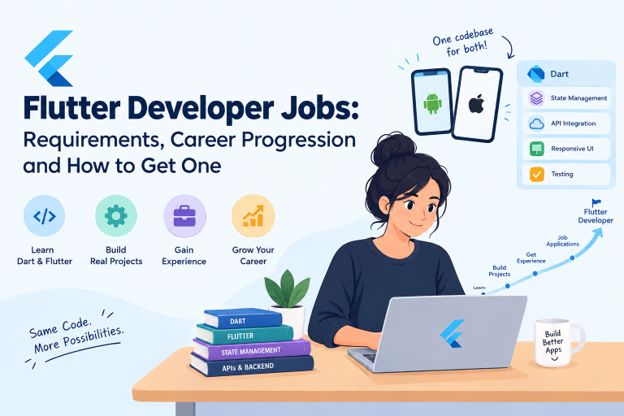
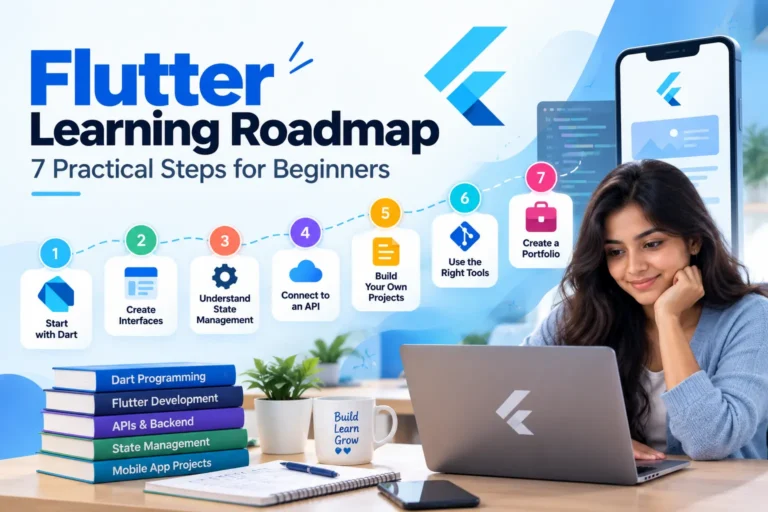
Dart → Flutter Basics → UI Projects → State Management → API Integration → Local Storage → Architecture → Testing → Portfolio → Interviews → Job Applications

In this way, you will have a clearer pathway to follow rather than trying to cover everything at once.

Conclusion

Having a job as a Flutter developer does not guarantee you having studied the maximum number of courses and learning the maximum number of widgets.

It all comes down to case studies. It is very crucial for you to first learn Dart and then Flutter. Once that is done, you can go ahead and learn about APIs, State Management, Architecture, and Testing. However, the most important thing is that you make your own applications.

Ready to Gain Real-World Development Experience?

Explore internship opportunities and hands-on project experience that can strengthen your development skills.

This Post Has One Comment

Comments are closed.

Stories Worth Reading

Insights, tutorials, and updates from our team — delivered fresh.