
AI in Software Testing: How the Role of Testers Is Changing in 2026
Author: Henna Thesnim
Quality Analyst, Dexpro Innovations
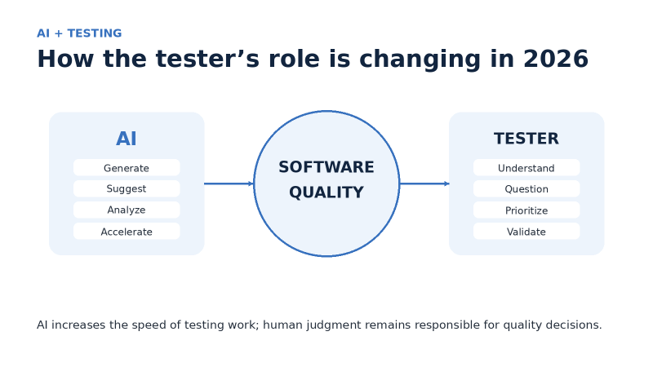
Artificial Intelligence is revolutionizing the approach of software testing in the year 2026, but not by replacing testers with it. Rather, artificial intelligence has taken over all the repetitive tasks from test case generation and script automation to defect analysis and risk prediction. Consequently, testers have started engaging themselves in validation, critical thinking, test planning, AI-enabled automation, and quality decision-making.
1. The shift: from executing tests to directing quality
Software testing has kept developing along with the development of software itself. From manual running of tests to automation, from CI/CD to continuous testing. AI would be the next step in the development of software testing for 2026, but its importance lies not in the mere addition of yet another tool in the testers’ kit.
AI would be capable of writing test cases, coding the automation process, analyzing failed tests, creating test data and summarizing all the collected test evidence. But the difficult part is what testers do after AI provides its output.
One way to look at the 2026 tester is through the lens of artificial intelligence increasing the velocity of creating testing artifacts, while the tester decides if those artifacts are right.
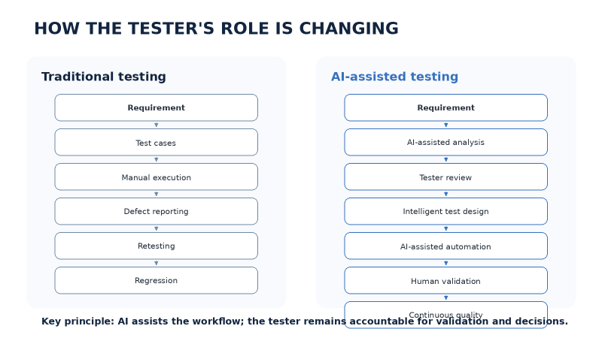
The role is moving upward
The shift is easiest to see in the work that AI can accelerate versus the work that still requires judgment.
AI can accelerate | The tester still owns |
Drafting scenarios | Risk, coverage and business relevance |
Generating automation | Architecture, locator quality and maintainability |
Explaining failures | Root-cause verification |
Creating data | Whether the data represents meaningful states |
Summarizing evidence | Release decisions and quality risk |
2. Where AI is entering the testing lifecycle
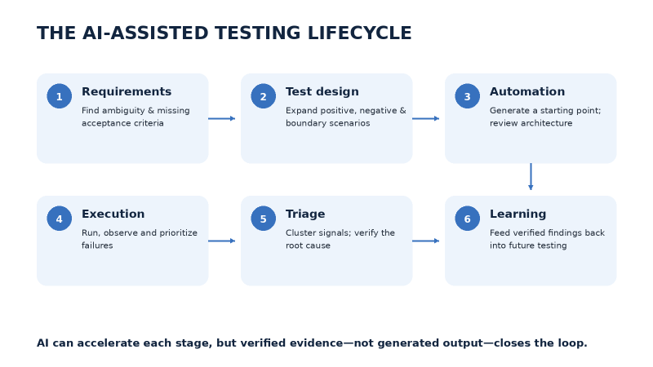
The uploaded draft correctly moves beyond the idea that AI in QA means only script generation. AI can participate across the lifecycle; from requirements to learning from production evidence.
Requirement analysis: quality can move left
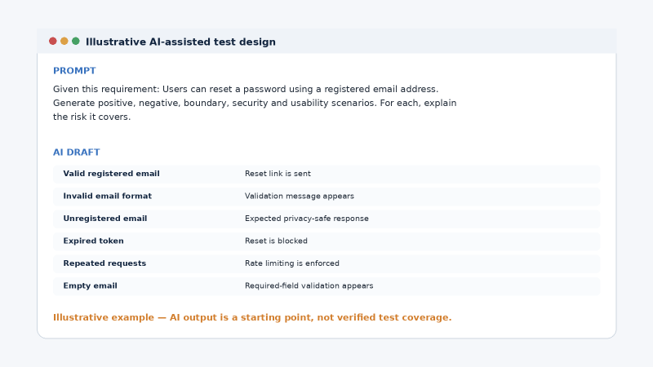
Think of a straightforward requirement such as “users must have the capability to change their password by using their registered email address.” At once the tester will think about different scenarios, which could involve correct and incorrect email addresses, empty input, expired links, and more. This is where an AI tool will come in handy as a challenger.
3. AI-assisted test case generation
Test-case generation is one of the most accessible AI use cases. It is also one of the easiest places to confuse quantity with quality.
AI output is a hypothesis, not coverage
An automatically produced list can be very impressive while overlooking the important threats. Take password reset for example: for this test case, a tester would have to consider things like token reuse, account enumeration, rate limiting, concurrency, email delivery failures and sessions. The AI will recommend all these; however, it is the tester who decides which of these are applicable to the particular product.
WHAT WORKS For increasing the size of the test space using AI, and then using different testing techniques, including equivalence partitioning, boundary value analysis, decision tables, state transition, risk analysis, and exploratory testing.
4. AI-generated automation: speed with a review tax
AI coding assistants can turn natural-language test scenarios into a first automation draft. That can remove a large amount of syntax friction for beginners and experienced engineers alike.
Why generated code can still be bad code?
Brittle locators can pass today and fail after a harmless UI change.
Duplicate assertions can make suites noisy without improving confidence.
Hard-coded delays can hide synchronization problems rather than solve them.
Generated code may ignore the project’s Page Object Model, fixtures, utilities or reporting conventions.
An assertion can be syntactically correct while checking the wrong business outcome.
This changes the automation tester’s value. The task is no longer only “write the script.” It is increasingly “design a maintainable test, review the generated implementation and prove that it tests the intended behavior.”
A USEFUL RULE If you cannot explain the locator, wait strategy, assertion and failure behavior in generated automation, you are not ready to approve that code.
5. Debugging and intelligent failure triage
As the automation suites scale, failure analysis emerges as a second challenge. AI can help with stack trace summarization, clustering of similar failures, and identifying potential sources of the issue. It provides the most value when multiple failures that are visible can have one root cause.
As the automation suites scale, failure analysis emerges as a second challenge. AI can help with stack trace summarization, clustering of similar failures, and identifying potential sources of the issue. It provides the most value when multiple failures that are visible can have one root cause.
Think about signals, not screenshots of the issues
A debugging request that is aided by AI should provide errors, code fragments, desired behavior, recent modifications, and environment data. The goal here is not to get an answer from AI but rather to get a list of hypotheses that could be verified by the tester.
| Weak prompt | Stronger prompt |
| “Fix this error.” | “Here is the failure, code and expected behavior. Give three likely root causes and one verification step for each.” |
| “Why is Playwright failing?” | “The locator resolves locally but times out in CI. Compare likely causes: selector, timing, environment and authentication.” |
| “Write a bug report.” | “Convert this verified failure into a concise defect report with expected, actual, environment, evidence and severity rationale.” |
Failure clustering is useful; but root cause still needs proof
The uploaded draft describes a common high-volume CI/CD problem: many failed tests can originate from one underlying service failure. That is a strong use case for clustering. But a cluster is a hypothesis about common cause; it should not automatically close or merge defects without verification.
Lastly, we understand that the future of software testing is not about a rivalry between AI and testers; instead, it is about how the use of both will evolve.
AI excels at generating ideas quickly: possibilities, code snippets, data, explanations, and clusters of evidence. The role of testers is still crucial for determining whether those ideas reflect reality in terms of the product, risk, and user.
The future valuable tester in 2026 won’t be simply the manual tester who mastered a chatbot, and won’t be simply the automation engineer who can generate code. It will be the quality professional combining testing principles, automation, data, product knowledge, and AI literacy, and knowing when the human touch is required.
Want to Build Practical Software Testing Skills?
AI is changing how testers work, but strong foundations in manual testing, automation, API testing, test design and quality assurance are still essential. Explore Edure’s Course With Placement to build practical, career-focused testing skills.
